

























































Surprising fact to start: a large share of DeFi losses aren’t from sophisticated zero-day exploits but from routine blind signing — users approving transactions or token allowances without knowing the exact state change that will occur. For a DeFi power user who manages multiple chains and frequent approvals, that single habit can quietly compound risk across wallets, dApps, and bridges. Rabby’s browser extension tackles this problem with a mechanism-first approach: simulate before you sign.
This article explains how Rabby’s Chrome-compatible extension implements transaction simulation, why that mechanism matters in the real world of EVM-based DeFi, where the approach breaks down, and how to make pragmatic choices (tools, workflows, and limits) that reduce operational risk. I’ll assume you already understand wallets and approvals at a surface level; the goal is to make the risk model sharper and more actionable.
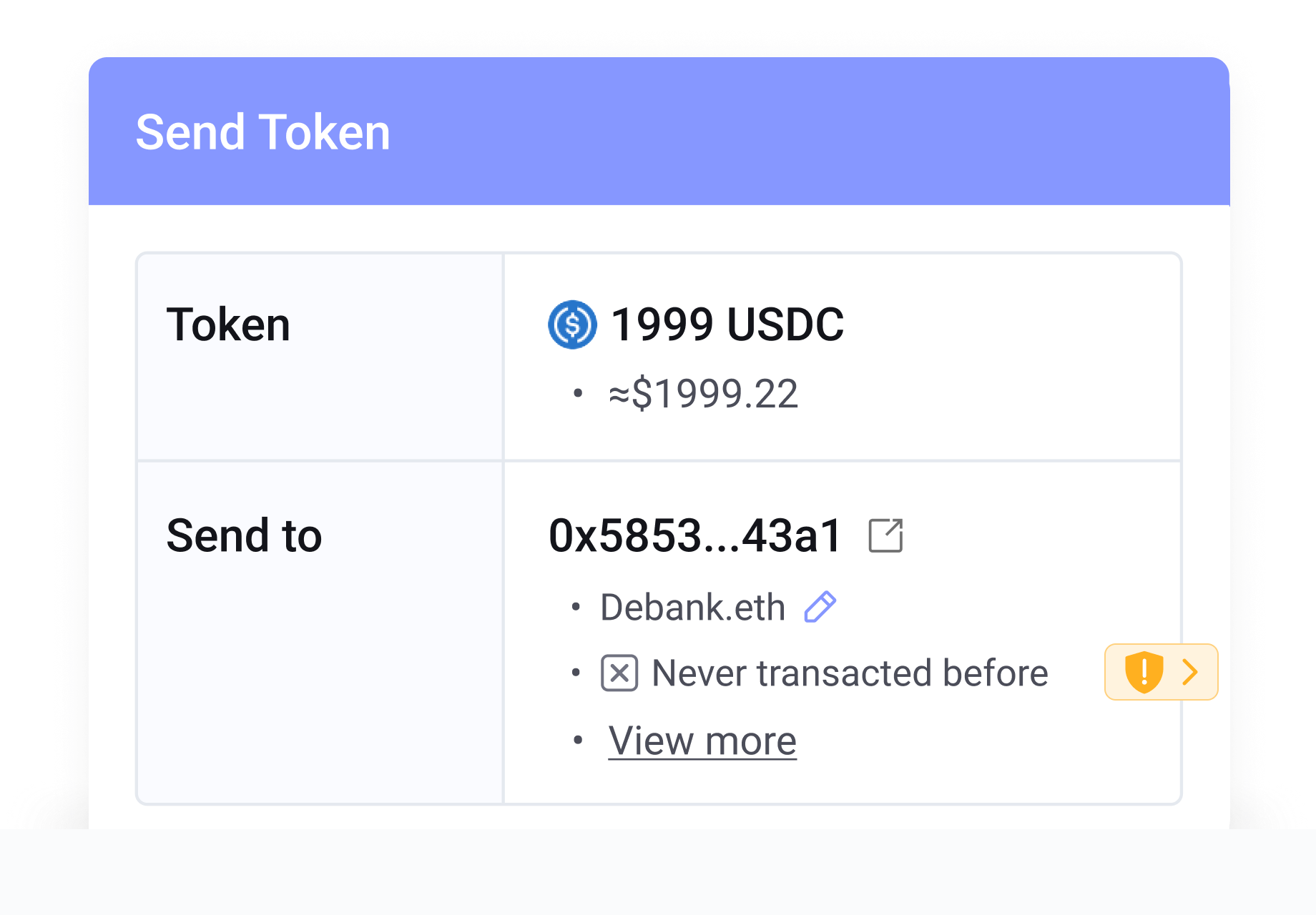
Table of Contents
What Rabby’s transaction simulation actually does — the mechanism
At its core, Rabby prevents “blind signing” by executing a dry-run of the proposed transaction against a local or remote node to estimate the state change before the user signs. That simulation returns concrete outputs: token balance deltas, gas cost estimates, and whether the destination contract has known red flags (for example, linked to past hacks). This differs from a superficial policy-grade warning: it shows a quantitative projection of the exact token and fee flows you can expect if the transaction is mined.
Mechanically, the wallet intercepts the dApp’s request and runs an eth_call or equivalent trace that emulates the transaction without altering chain state. The extension then parses the result and displays the affected balances and fee breakdown. Because it does not require the transaction to be on-chain, the user sees the consequences before signing. The UX pairs this with a pre-transaction risk scan that marks previously hacked contracts, unusual approval patterns, and missing recipient addresses.
Why simulation matters more than alerts for DeFi power users
There are three reasons simulation is a higher-fidelity defense than binary warnings. First, it converts abstract warnings into precise outcomes: instead of “this contract is risky,” you see “this transfer will move X tokens and cost Y gas.” That clarity reduces cognitive friction during fast-moving trades. Second, it mitigates social-engineering vectors: many phishing dApps mimic legitimate UIs and rely on users agreeing to opaque approvals; simulation disrupts that approach by exposing the concrete transfer. Third, for multi-chain users, one concise preview avoids mistakes caused by network confusion — Rabby already offers automatic network switching, so the preview is in the correct chain context.
Practically, that translates into fewer accidental approvals for malicious contracts, a lower likelihood of losing funds to approval-based drains, and better-informed decisions when interacting with liquidity pools, bridges, or contract upgrades.
Installing Rabby on Chrome: what to expect and setup trade-offs
Rabby is available as a Chromium-based browser extension (Chrome, Brave, Edge). Installation is straightforward: add the extension, create or import a wallet (seed phrase or private key), and optionally connect a hardware device such as Ledger or Trezor for higher-assurance key custody. Rabby also includes a “Flip” toggle that lets you switch default integration between Rabby and MetaMask, which is handy if you maintain both for compatibility testing.
Trade-offs during setup are practical: enabling convenience features like automatic network switching and cross-chain gas top-up accelerates workflows but slightly increases the attack surface because more automated cross-chain calls occur on your behalf. The mitigation: pair Rabby’s extension with a hardware wallet for high-value operations. Rabby supports a broad set of hardware devices (Ledger, Trezor, Keystone, CoolWallet, GridPlus, BitBox02), letting you combine transaction simulation with offline key signing to reduce exposure.
Where the simulation approach adds value — and its limits
Simulation is powerful but not omnipotent. It reliably shows token deltas and gas costs for deterministic EVM transactions and common contract interactions. It also helps identify suspicious approval requests, particularly the classic “infinite approval” vectors used by malicious contracts. However, there are important boundary conditions:
– Non-deterministic behavior: some contracts rely on block timestamps, on-chain randomness, or oracle data that can change between simulation and execution. Simulation may under- or over-estimate outcomes in those cases. Always treat simulations as best estimates, not guarantees.
– Off-chain or time-dependent approvals: if a contract’s behavior depends on state changes triggered by other transactions that occur between simulation and your eventual confirmation, the simulation may miss those intermediate steps.
– Zero-day vulnerabilities and unknown malicious contracts: Rabby’s pre-transaction risk scanning flags known hacked contracts and suspicious patterns, but an auditable open-source codebase can’t flag unknown malicious logic until it’s recognized. Open-source status and audits reduce but do not eliminate this residual risk.
Real-world incident history and what it teaches
Rabby’s codebase and ecosystem are not hypothetical; in 2022 a smart contract associated with Rabby Swap was exploited for roughly $190,000. The response — freezing the contract, compensating affected users, and tightening audits — demonstrates two lessons. First, even projects with a security-first posture can have coding failures in ancillary contracts. Second, the incident changed the threat model: users should assume any single feature (like a swap contract) could fail, and prioritize compartmentalization (hardware wallets, multi-sig, limited approvals) rather than blind trust.
That episode is also a practical reason to value on-the-fly approval revocation and simulation: if you spot and remove risky approvals quickly, you reduce the window an attacker needs to exploit a flaw.
How Rabby fits into an institutional or multi-sig security workflow
For institutional users or funds, Rabby integrates with enterprise custody and multi-sig systems such as Gnosis Safe, Fireblocks, Amber, and Cobo. The operational advantage: simulation provides a transparent snapshot that signers or gatekeepers can review before executing. In a multi-sig context this reduces the cognitive load on approvers who may not have deep protocol-level knowledge; they can verify the concrete balance changes rather than parse raw calldata.
Trade-off: signed approval processes add latency to execution, which matters for time-sensitive strategies. Therefore, institutions must design thresholds — which classes of transactions can be auto-signed with simulation-based assurance, and which require manual multi-sig confirmation. A practical heuristic: use simulation + hardware wallet for routine, low-value flows and reserve full multi-sig sign-off for high-value or novel contract interactions.
Decision-useful framework: when to rely on simulation and when to escalate
Here is a simple three-step rule you can reuse:
1) Simulate-first: Always view the simulation output before signing. If the estimated token flow matches intent and gas estimates are sensible, proceed.
2) Verify provenance: If the contract is unfamiliar or the simulation shows a wide or unexpected token delta, escalate. Check contract source, Etherscan verification, and third-party audit flags.
3) Harden or refuse: For high-value transfers, enable hardware signing and require multi-sig approval. If the transaction depends on off-chain data or shows non-deterministic elements, consider a delay window or refuse until the behavior is understood.
This framework converts simulation from a convenience into an operational control layer.
Practical limitations you need to know
Rabby lacks a native fiat on-ramp and in-wallet staking at present — important practical frictions if you want an all-in-one consumer experience. You’ll still need external on-ramps to buy base tokens and an external staking interface for some protocols. Additionally, simulations can produce false reassurance in edge cases with non-deterministic contracts. Finally, while Rabby’s open-source MIT license invites audits, open code is a necessary but not sufficient condition for safety: responsible security depends on active audits, bug-bounty coverage, and user discipline.
For users in the US, regulatory contours also matter. Non-custodial wallets like Rabby reduce counterparty risk but do not eliminate compliance risks tied to certain token activities. Institutional users should pair Rabby with compliance monitoring tools if they operate in regulated corridors.
If you want to explore the extension itself, the team publishes resources and an install page for the rabby wallet that walk through imports, hardware setup, and simulation UI features.
What to watch next
Signal-watchers should monitor three areas: (1) improvements in on-chain tracing that make simulations more accurate for time-dependent contracts, (2) adoption of standardised simulation APIs among wallet providers (which would raise baseline user protection), and (3) the evolution of approval UX standards — e.g., stronger defaults that limit infinite approvals and present intent-matching descriptions. Any of these shifts would change how much users can rely on simulation as a defensive layer.
FAQ
How reliable are Rabby’s transaction simulations?
Simulations are reliable for deterministic EVM calls: they show expected token deltas and fees accurately when the contract’s logic depends only on current chain state. They are less reliable for transactions influenced by future oracle updates, timestamps, or unpredictable off-chain inputs. Treat simulation as a high-quality estimate, not an absolute guarantee.
Can transaction simulation prevent all scams and hacks?
No. Simulation reduces many common risks — especially blind signing and malicious approvals — but it cannot prevent zero-day vulnerabilities in audited contracts, social-engineered approvals where users ignore the simulation, or attacks that exploit hardware wallet firmware. Use simulation alongside narrow approvals, hardware signing, approval revocation, and multi-sig for layered defense.
Does using Rabby mean I must stop using MetaMask or other wallets?
No. Rabby is designed to be interoperable: it offers a Flip toggle for easily switching with MetaMask and supports importing existing keys. The practical approach is to use Rabby where its simulation and approval-management features provide the most utility, and retain other wallets for workflows they uniquely support.
Should I use a hardware wallet with Rabby?
Yes for high-value accounts. Pairing Rabby’s simulation and approval revocation with a Ledger, Trezor, or similar device gives two distinct guarantees: clear preview of intent and stronger custody for private keys. This combination materially reduces the risk of accidental or malicious fund movement.